Chemical processing plants in Dahej need valves that can handle corrosive liquids without compromising pipeline performance. A PTFE Lined Butterfly Valve In Dahej offers a practical flow-control solution for demanding chemical handling systems, supplied by Flow Line Valve.
Why PTFE Lining Matters in Chemical Pipeline Operations
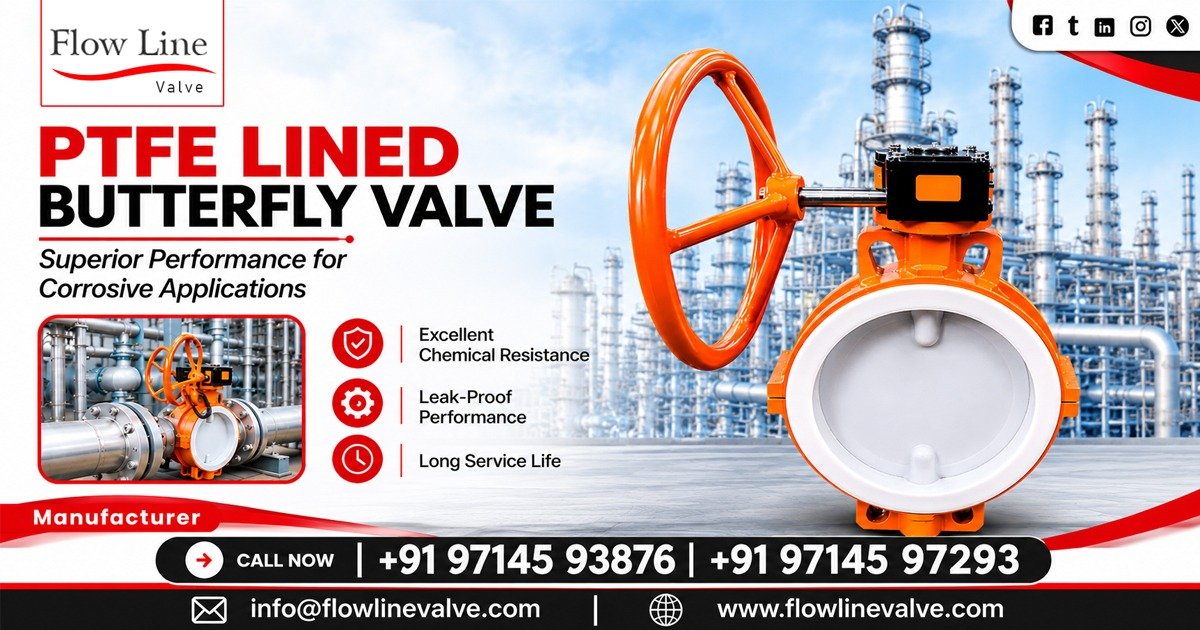
A PTFE lined butterfly valve is an industrial quarter-turn valve designed to regulate or isolate liquid flow in pipelines. Its internal PTFE lining creates a protective barrier between the process fluid and the metal valve body.
This construction is particularly relevant where conventional metal valves may experience corrosion due to contact with aggressive chemicals.
For industries operating around Dahej, valve selection is important because chemical transfer systems often handle different liquids under varying pressure and temperature conditions.
The valve can be considered for:
- Acid and chemical transfer pipelines.
- Chemical storage and distribution systems.
- Pharmaceutical manufacturing processes.
- Dyes and pigment production.
- Fertilizer and petrochemical plants.
- Industrial wastewater treatment systems.
The actual suitability depends on the chemical concentration, operating temperature, pressure and compatibility of all wetted components.
What Should Buyers Check Before Choosing a Lined Butterfly Valve?
Selecting a valve only by its nominal pipe size can create operational problems. Buyers should evaluate the complete pipeline requirement before confirming an order.
| Selection factor | What to verify |
| Valve size | Match the pipeline diameter and connection dimensions. |
| Lining material | Confirm PTFE compatibility with the process chemical. |
| Body material | Evaluate cast steel, stainless steel or other suitable construction options. |
| Pressure rating | Match the valve rating with the maximum operating pressure. |
| Temperature | Check continuous and occasional temperature conditions. |
| End connection | Select wafer, lug or flanged construction according to pipeline design. |
| Operation | Choose lever, gearbox, pneumatic or electric operation. |
| Maintenance | Consider accessibility for inspection and servicing. |
Important buying consideration: PTFE lining alone does not determine the complete chemical resistance of a valve. The disc, seat, stem sealing arrangement and other wetted components must also be suitable for the process medium.
How the Valve Controls Chemical Flow Inside a Pipeline
A butterfly valve uses a rotating disc positioned inside the valve body. Its quarter-turn movement changes the flow passage without requiring a large installation space.
The operating sequence is straightforward:
Step 1: Pipeline Connection
The valve is positioned between compatible pipeline flanges. Proper alignment and suitable bolting help maintain a secure connection.
Step 2: Opening the Valve
The lever, gearbox or actuator rotates the disc to allow process liquid to pass through the pipeline.
Step 3: Regulating or Isolating Flow
The disc position changes the available flow passage. For applications requiring accurate control, the selected valve and actuator must be suitable for the intended control duty.
Step 4: Closing the Valve
When the disc reaches its closed position, the seating arrangement provides the required shut-off performance, subject to the specified pressure and operating conditions.
The operating mechanism can be selected according to manual operation requirements or the level of automation used in the plant.
Installation Conditions That Affect Valve Performance
Even a properly selected valve can develop problems if the pipeline installation is incorrect. Chemical plants should pay attention to the following points:
- Flange alignment: Ensure both pipeline flanges are properly aligned before tightening.
- Disc clearance: Confirm that the disc can rotate freely without contacting internal pipe surfaces.
- Gasket arrangement: Follow the manufacturer’s installation instructions for the selected valve design.
- Bolting: Use the recommended fasteners and tightening sequence.
- Pipeline support: Avoid transferring excessive piping loads to the valve body.
- Actuator clearance: Keep sufficient space for operation and future servicing.
Before installation or maintenance, isolate the pipeline, depressurize it and follow the plant’s chemical-handling safety procedures.
Inspection Points That Help Prevent Unexpected Valve Problems
Regular inspection is important in chemical pipelines because operating conditions can affect sealing performance and internal components.
Maintenance teams should monitor:
- External leakage around flange connections.
- Changes in operating torque.
- Difficulty in opening or closing the disc.
- Damage, deformation or deterioration of the PTFE lining.
- Corrosion or wear in exposed metallic components.
- Unusual actuator movement or operating noise.
| Observed problem | Possible area to inspect |
| Leakage at flange | Alignment, bolting and sealing surfaces |
| Leakage through closed valve | Seat condition, disc position and operating mechanism |
| Stiff operation | Deposits, mechanical wear or actuator issues |
| Uneven movement | Stem, gearbox or actuator connection |
| Lining damage | Chemical compatibility and operating conditions |
Maintenance intervals should be determined according to process severity, operating frequency and manufacturer recommendations.
Product Details to Confirm During Technical Evaluation
Flow Line Valve lists PTFE lined butterfly valves with different construction and operating configurations. The product information includes the following technical options:
| Parameter | Listed product details |
| Valve design | Butterfly valve |
| Construction | Wafer / Lug / Flanged |
| Size range | 15 NB to 600 NB |
| Body material | ASTM A216 Gr. WCB / CF8 / CF8M |
| Lining | PTFE (PFA optional) |
| Seat material | PTFE |
| Pressure rating | PN10 / PN16 |
| Temperature range | -29°C to 200°C |
| Operating options | Lever / Gear / Pneumatic / Electric actuator |
These are product-page specifications, not a guarantee that every combination is available. Confirm the exact configuration, design limits and chemical compatibility before ordering.
Engineering Requirements That May Change the Valve Configuration
Different chemical processes require different valve arrangements. A valve suitable for one transfer line may not be appropriate for another.
For a PTFE Lined Butterfly Valve In Dahej, buyers should share the following information during technical discussions:
- Process medium: Chemical name, concentration and possible impurities.
- Pipeline details: Nominal diameter, flange standard and available installation space.
- Operating pressure: Normal pressure and maximum expected pressure.
- Temperature conditions: Continuous operating temperature and temperature variations.
- Operating frequency: Number of opening and closing cycles.
- Control requirement: Manual isolation, automated operation or flow regulation.
- Project environment: Indoor or outdoor installation and surrounding environmental conditions.
Pneumatic or electric actuation may be considered where the plant uses automated process controls. However, actuator sizing should account for operating torque and actual service conditions.
Four Service Areas for Industrial Valve Requirements
- Product consultation and chemical compatibility assessment.
- Valve configuration and operating mechanism selection.
- Technical coordination for pipeline installation requirements.
- Maintenance guidance and after-sales technical assistance.
Industrial Supply Relevance Across Dahej and Gujarat
Dahej has a significant concentration of chemical, petrochemical, pharmaceutical, fertilizer and process industries. These facilities require suitable corrosion-resistant pipeline components for chemical transfer and process isolation.
GIDC Gujarat+2
Flow Line Valve can support industrial buyers evaluating valve requirements in Dahej, Bharuch, Ankleshwar, Panoli, Jhagadia, Vilayat, Saykha, Vagra, Palej, Vadodara, Ahmedabad, Sanand, Halol, Kalol, Gandhinagar, Surat, Hazira, Vapi, Ankleshwar GIDC, Nandesari, Savli, Rajkot, Morbi and Jamnagar.
How Flow Line Valve Supports Industrial Buyers
Selecting a valve supplier involves more than comparing product prices. Buyers need clear technical information, suitable construction and coordination throughout the purchasing process.
Flow Line Valve manufactures PTFE, PFA and FEP lined valves, pipes and fittings for industrial flow applications. Its product range includes lined butterfly valves with different connection and operating arrangements.
With manufacturing support from Ahmedabad, Gujarat, India, the company can assist customers in understanding product requirements and evaluating suitable valve configurations.
Visit https://flowlinevalve.com/ to explore its industrial valve range and discuss project requirements.
Frequently Asked Questions
Q1: Why are PTFE lined butterfly valves considered for chemical industries?
A: Their internal PTFE lining provides a corrosion-resistant barrier for compatible process chemicals. They are commonly evaluated for chemical transfer and pipeline isolation duties.
Q2: Which operating mechanism should I select for a chemical pipeline?
A: Lever operation may suit smaller or manually operated lines, while gearbox, pneumatic and electric actuators can be considered according to valve size, operating torque and automation requirements.
Q3: How can I identify lining damage during maintenance?
A: Inspect accessible internal surfaces during scheduled maintenance and check for visible cracks, peeling, deformation or chemical deterioration. Follow the manufacturer’s inspection procedure.
Q4: What information should I provide when requesting a valve quotation for Dahej?
A: Share the pipeline size, chemical name and concentration, pressure, temperature, connection type and operating method. These details help the supplier assess the appropriate valve configuration.
Conclusion
Choosing a suitable PTFE Lined Butterfly Valve In Dahej requires careful evaluation of chemical compatibility, pressure, temperature, valve construction and operating mechanism. Flow Line Valve offers industrial valve solutions with manufacturing support from Ahmedabad, Gujarat, India, helping buyers assess their pipeline requirements.
Contact Flow Line Valve through its website to discuss your chemical pipeline requirements and request technical assistance for suitable valve selection.
Call Us:
+91 97145 93876
+91 93289 35785
+91 97145 97776
Mail Us:
flowlinevalve@gmail.com
sales@flowlinevalve.com
For further inquiries or customized solutions, feel free to contact us.