Industries in Delhi handling corrosive chemicals need reliable piping components to prevent leakage and protect pipeline connections. PTFE Lined Blind Flanges In Delhi offer a practical isolation solution, with Flowline Valve supporting industrial requirements through manufacturing coordination from Ahmedabad, Gujarat, India.
Understanding PTFE Lined Blind Flanges in Corrosive Piping Systems
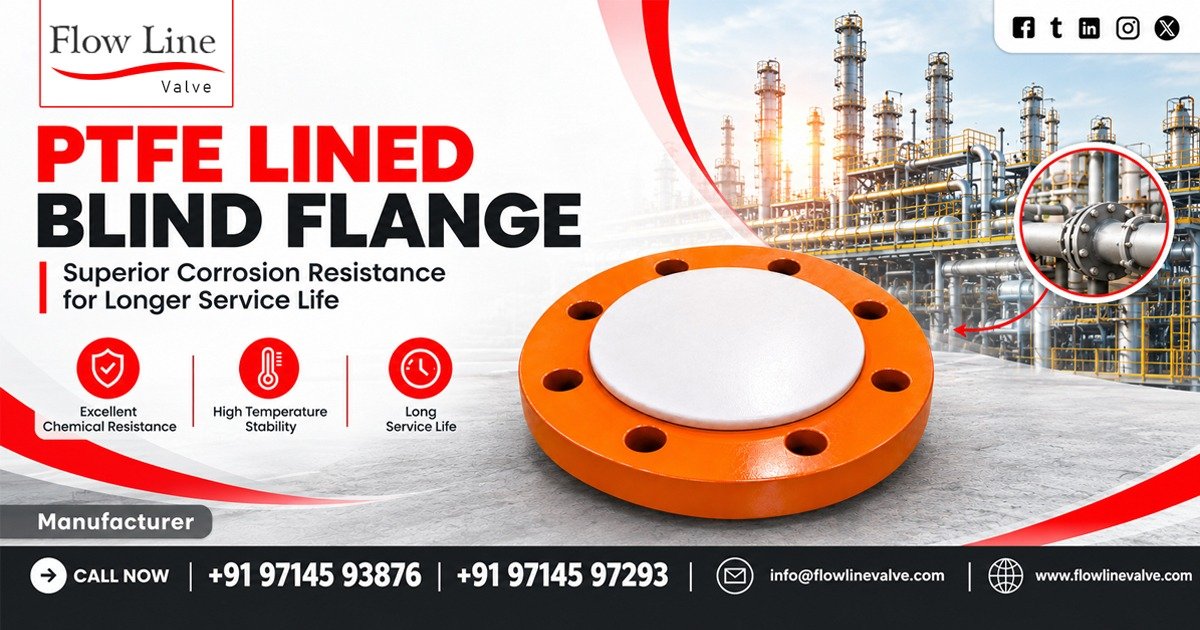
A PTFE lined blind flange is a solid pipe closure component designed to block the flow of liquid or gas at the end of a pipeline, vessel connection, or unused nozzle. Its internal contact surface is protected with Polytetrafluoroethylene (PTFE), a material known for its chemical resistance and non-reactive properties.
These flanges are useful in industrial environments where conventional metal surfaces may be exposed to aggressive chemicals.
The PTFE lining helps:
- Reduce direct contact between corrosive media and the base metal.
- Protect the flange’s internal surface from chemical attack.
- Support isolation of pipeline sections during maintenance or process changes.
- Reduce contamination risks in suitable chemical-handling applications.
- Provide a corrosion-resistant contact surface when correctly selected.
Industries such as chemical processing, pharmaceuticals, dyes and pigments, fertilisers, and water treatment may require these components for their piping arrangements.
Selecting the Correct Flange for Your Pipeline Conditions
Choosing a suitable flange requires more than matching the pipe diameter. Buyers should evaluate the complete operating environment before placing an order.
| Selection factor | What to verify |
| Nominal size | Match the pipeline or nozzle dimensions. |
| Pressure rating | Confirm suitability for the system’s design pressure. |
| Temperature | Check the operating temperature against PTFE lining limitations. |
| Chemical compatibility | Verify PTFE suitability for the actual process medium. |
| Base material | Select a suitable metal body according to operating conditions. |
| Facing and dimensions | Confirm flange facing, thickness, and connection details. |
| Gasket compatibility | Ensure the sealing arrangement suits the pipeline. |
| Operating conditions | Consider pressure fluctuations and temperature cycles. |
Important: PTFE has temperature and mechanical limitations. The complete flange assembly must be evaluated for the intended pressure, temperature, and chemical exposure.
How a PTFE Lined Blind Flange Closes a Pipeline
The working principle is straightforward, but correct installation is essential for reliable sealing.
Step 1: Position Identification
Identify the pipeline opening, equipment nozzle, or connection that needs to be closed. Check the required flange size and pressure rating.
Step 2: Surface and Alignment Check
Inspect the mating flange face, bolt holes, and sealing surfaces. Ensure the connection is clean and properly aligned.
Step 3: Flange Installation
Position the blind flange with the appropriate gasket or approved sealing arrangement. Align the bolt holes before inserting the fasteners.
Step 4: Controlled Tightening
Tighten the bolts in a suitable cross-pattern sequence using the specified torque requirements. Avoid uneven loading that could damage the PTFE lining or affect sealing.
After installation, conduct the required pressure or leak test according to the applicable project procedure before returning the pipeline to service.
Inspection Points That Matter Before Purchasing
Before ordering a lined blind flange, procurement teams should confirm that the supplied component matches the pipeline design and process conditions.
Important checks include:
- Base metal: Confirm whether the flange body is required in carbon steel, ASTM A105, SS304, or SS316.
- Lining condition: Inspect the PTFE surface for cracks, scratches, uneven areas, or visible defects.
- Lining thickness: Confirm the specified thickness against the approved product drawing.
- Dimensional accuracy: Check outside diameter, thickness, bolt-hole arrangement, and facing dimensions.
- Pressure suitability: Verify the flange rating and complete assembly against the design conditions.
- Testing and documentation: Request applicable inspection records, dimensional reports, and test documentation.
- Storage and handling: Ensure protective packaging prevents damage to the lined surface during transportation.
Flowline Valve’s product information lists several base-material options for lined blind flanges, including IS 2062, ASTM A105, SS304, and SS316. Final material selection should depend on the project specification.
Matching Flange Construction with Specific Project Requirements
Different industrial projects may require different flange configurations. A chemical storage facility, for example, may have different operating conditions from a pharmaceutical processing plant.
Flowline Valve’s product information covers PTFE lined blind flanges in different sizes and also identifies PFA and FEP lined blind flange options. Buyers should confirm the exact construction and material availability for their requirement.
When discussing a project, provide:
- Required nominal pipe size.
- Flange standard and pressure class.
- Base metal preference.
- PTFE lining requirements.
- Operating temperature and pressure.
- Chemical name and concentration.
- Required quantity and delivery schedule.
Sharing these details helps avoid dimensional mismatches and unsuitable material selection.
Services
- Product consultation and identification of suitable lined flange requirements.
- Technical coordination for size, material, and pressure-rating selection.
- Manufacturing coordination based on approved project specifications.
- Assistance with product documentation and order-related technical queries.
PTFE Lined Blind Flange Requirements Across Delhi’s Industrial Areas
Chemical processing, pharmaceutical manufacturing, engineering facilities, water treatment plants, and industrial infrastructure projects in Delhi may require corrosion-resistant pipeline closure components. PTFE Lined Blind Flanges In Delhi can support suitable piping arrangements when selected according to process conditions. Relevant industrial and commercial locations include Okhla Industrial Area, Bawana Industrial Area, Narela Industrial Area, Patparganj Industrial Area, Mayapuri Industrial Area, Naraina Industrial Area, Wazirpur Industrial Area, Jhilmil Industrial Area, Lawrence Road Industrial Area, Badli Industrial Area, Anand Parbat Industrial Area, Mangolpuri Industrial Area, Kirti Nagar, Mohan Cooperative Industrial Estate, Rithala, Rohini, Mundka, Tikri Kalan, Samaypur Badli, Sultanpur, Dwarka, Najafgarh, Connaught Place, and Nehru Place.
How Flowline Valve Supports Industrial Flange Requirements
Selecting a lined flange supplier involves checking product suitability, technical understanding, and the ability to coordinate requirements accurately.
Flowline Valve works with industrial requirements involving PTFE lined valves, pipes, fittings, and accessories. Its product range includes PTFE lined blind flanges, with different size and material requirements identified in its product information.
The company provides manufacturing support from Ahmedabad, Gujarat, India, for customers handling industrial piping projects in Delhi and other locations.
Visit the official website, https://flowlinevalve.com/, to explore its lined piping products and submit your requirements.
Frequently Asked Questions
Q1: Why are PTFE lined blind flanges used in chemical pipelines?
A: They provide a lined closure surface that helps protect the underlying metal from direct chemical contact. Their suitability depends on the chemical, concentration, temperature, and pressure.
Q2: Which base materials are available for lined blind flanges?
A: Commonly specified options include carbon steel grades such as IS 2062 and ASTM A105, along with SS304 and SS316. Confirm the available construction with the supplier.
Q3: What information is needed to order a PTFE lined blind flange?
A: Buyers should share the nominal size, pressure rating, flange standard, base material, operating temperature, chemical details, and required quantity.
Q4: How should a PTFE lined blind flange be maintained?
A: Inspect the lining and sealing surfaces during planned maintenance. Avoid sharp tools, excessive bolt tightening, and handling practices that may damage the PTFE surface.
Conclusion
Choosing the right PTFE lined blind flange requires attention to chemical compatibility, pressure rating, dimensions, base material, and installation conditions. Industrial buyers in Delhi can discuss their piping requirements with Flowline Valve, supported by manufacturing coordination from Ahmedabad, Gujarat, India.
Contact Flowline Valve through flowlinevalve.com to discuss PTFE lined blind flange specifications, product selection, and industrial project requirements.
Call Us:
+91 97145 93876
+91 93289 35785
+91 97145 97776
Mail Us:
flowlinevalve@gmail.com
sales@flowlinevalve.com
For further inquiries or customized solutions, feel free to contact us.